Research

Active Research Projects

Advancing Nanoparticle Assembly for Tunable Plasmonic Properties

Advancing Nanoparticle Assembly for Tunable Plasmonic Properties

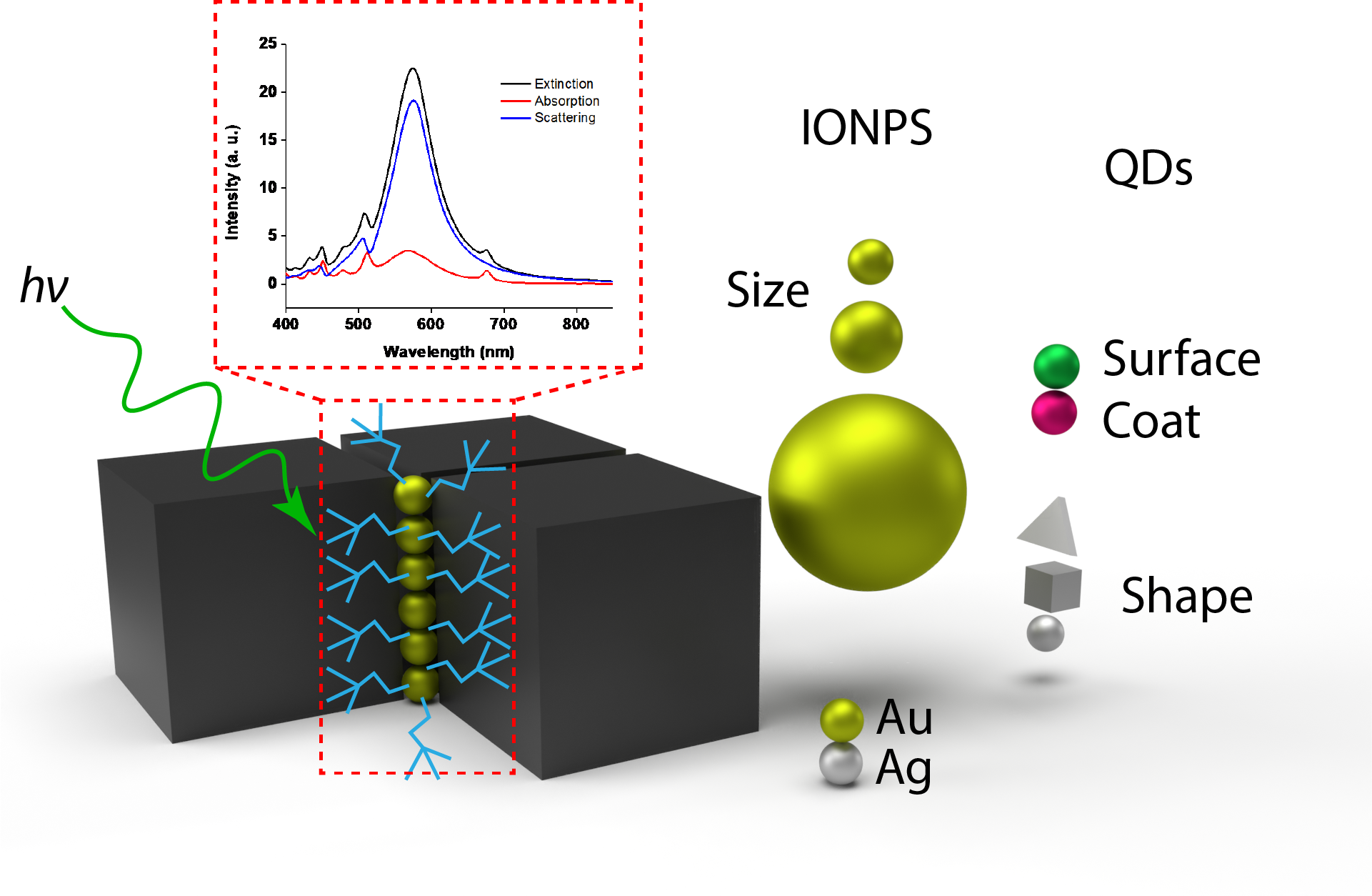
Engineering metallic nanoparticles with precise geometry to achieve tunable plasmonic resonances for ultrasensitive sensing, cancer biomarker detection, solar energy harvesting, and rapid diagnostics.

Our group engineers plasmonic nanoparticle assemblies—clusters, chains, and arrays of gold and silver nanocubes and nanorods—whose optical response can be dialed by controlling interparticle separation, orientation, and the dielectric environment. At sub-nanometer gap distances, near-field coupling gives rise to intense electromagnetic "hot spots" that amplify spectroscopic signals by many orders of magnitude. **Key research thrusts:** - **Microchip-Based Devices for Ultrafast Information Processing and Cancer Biomarkers** — Integrating plasmonic nanocube chains on chip-scale platforms to enable simultaneous rapid-signal processing and label-free detection of cancer-associated biomolecules. - **Hybrid Metal/Nanoparticle-Semiconductor Thin Films for Rapid Cancer Detection** — Coupling metal nanoparticles with semiconductor substrates to create robust, high-sensitivity SERS substrates that detect cancer biomarkers from patient samples. - **Enhancing Solar Panels with Nanoplasmonic Coatings** — Depositing nanoplasmonic coatings on photovoltaic surfaces to boost light absorption across the solar spectrum through localized surface plasmon resonance.
Innovative Approaches to Cancer Treatment Using Nanoparticle-Based Therapies

Innovative Approaches to Cancer Treatment Using Nanoparticle-Based Therapies

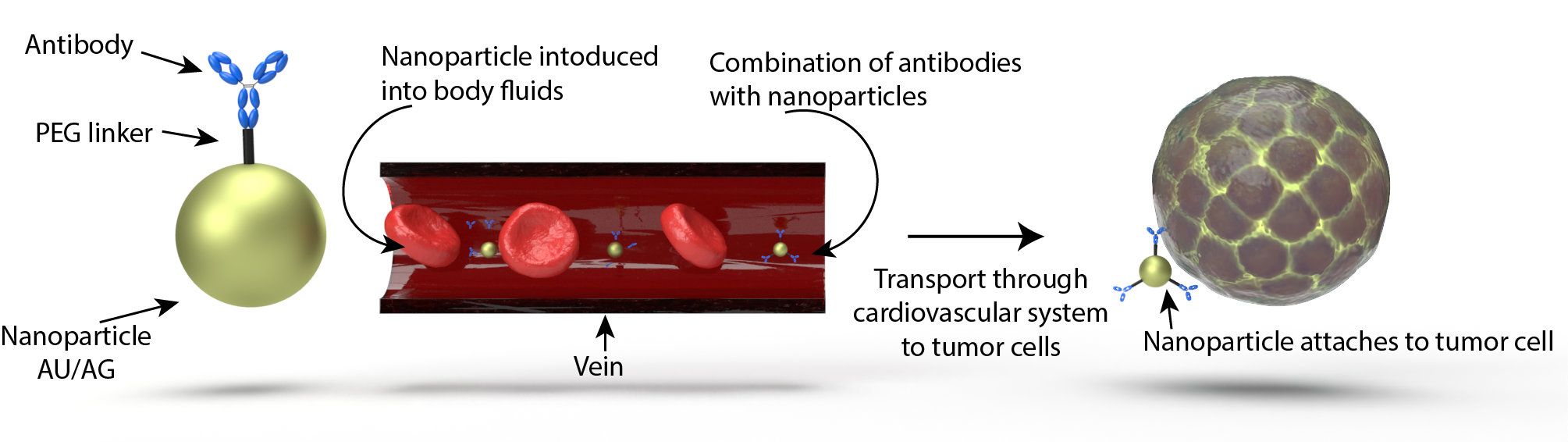
Harnessing gold nanoparticles and engineered nanoconstructs for synergistic photothermal, chemotherapy, and photodynamic cancer treatments, with computational modeling guiding nanoparticle design.

Our lab develops nanoparticle-based therapeutic platforms that exploit plasmon-enhanced photothermal effects to selectively destroy tumor cells while sparing healthy tissue. By combining gold nanorods, mesoporous silica carriers, and stimuli-responsive drug release, we achieve synergistic chemo-photothermal outcomes that outperform either modality alone. **Key research thrusts:** - **Nanoparticle-Based Coatings for Enhanced Light Absorption** — Designing nanoparticle surface coatings that maximize near-infrared light absorption and convert photon energy to localized heat for photothermal tumor ablation. - **Synergistic Therapy Using Gold Nanoparticles** — Engineering gold nanorod constructs loaded with chemotherapeutic agents (e.g., doxorubicin) that release drug upon NIR or pH triggers, combining photothermal and chemical cytotoxicity for lung and other cancers. - **Computational Modeling for Biomolecular Processes** — Using the discrete dipole approximation (DDA) and molecular dynamics simulations to predict plasmon coupling, protein corona formation, and drug-release dynamics, accelerating the rational design of therapeutic nanoparticles.
Active Metal Nanoparticles for Monitoring Surface Catalytic Reactions

Active Metal Nanoparticles for Monitoring Surface Catalytic Reactions

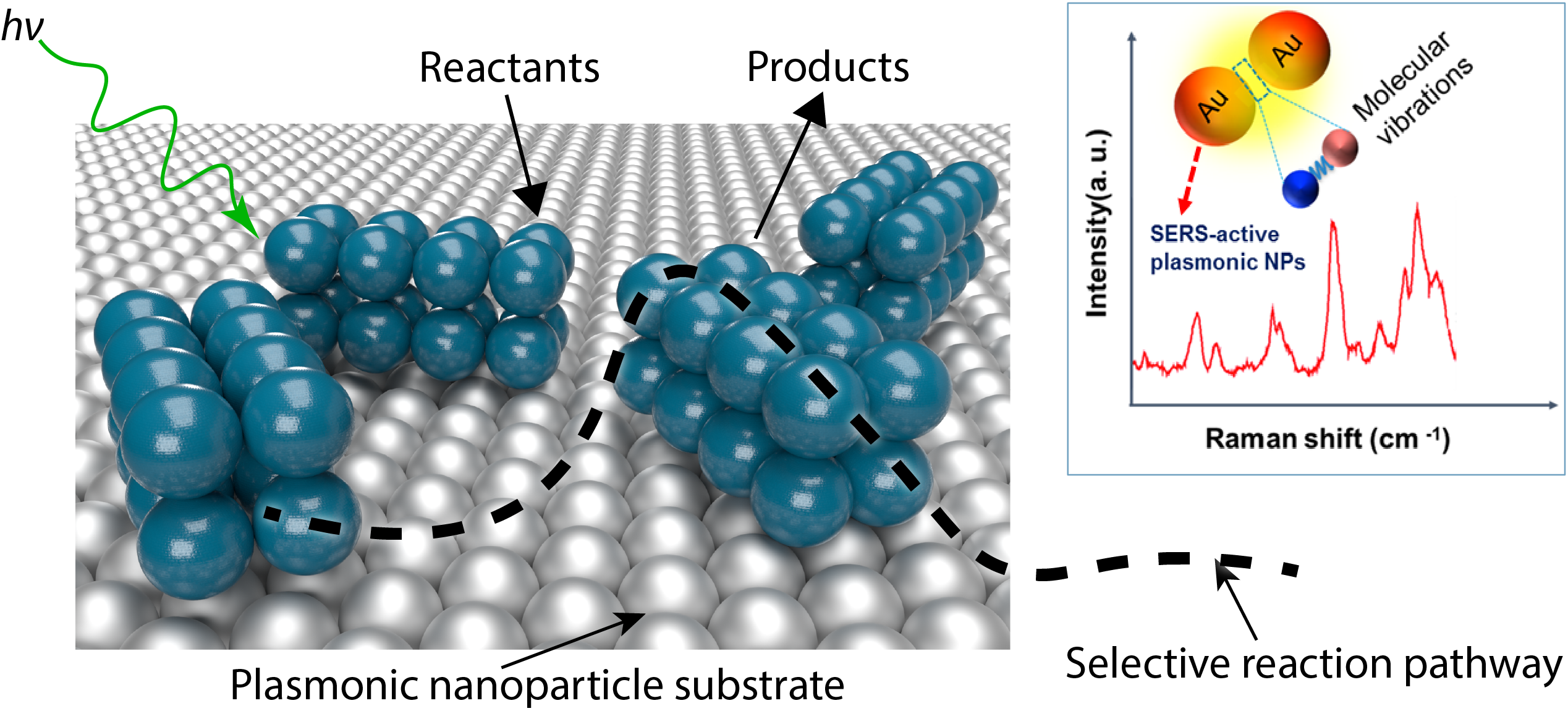
Developing advanced plasmonic nanostructures with precisely tunable geometries to probe and enhance surface-catalytic and photocatalytic reactions in real time using SERS and LSPR spectroscopy.

Plasmonic nanoparticles are not merely passive sensors—they actively participate in surface chemical reactions by concentrating electromagnetic energy at catalytic sites. Our research uses in-situ surface-enhanced Raman spectroscopy (SERS) and localized surface plasmon resonance (LSPR) to track bond-breaking and bond-forming events on metal nanoparticle surfaces with molecular specificity. **Key research thrusts:** - **Advanced Plasmonic Nanostructures with Precise Geometry** — Synthesizing silver and gold nanocubes, nanorods, and nanoshells with controlled corner sharpness and edge length to achieve reproducible hot-spot geometries and tunable plasmon resonances from visible to near-infrared. - **Photocatalysis and Nanobiocatalysis** — Exploiting plasmon-driven hot-electron injection into semiconductor or enzyme-coated supports to accelerate oxidation, reduction, and organic synthesis reactions under visible-light irradiation without external heating. - **In-Situ Reaction Monitoring** — Coupling SERS-active nanoparticle arrays with microfluidic flow cells to observe catalytic reaction intermediates in real time, enabling mechanistic studies of copper electroplating, organic condensation, and aerobic oxidation.